Your developers are already using AI.
Can you tell what it is buying you?
Rapid Dev turns agentic coding from a personal habit into a team practice: a plan the agent works through one story at a time, 108 quality gates it has to pass, and a meter on every hour spent — human and AI, per story, from day one. One plan, one record, and nobody writing status updates.
We built this platform with this platform.
Rapid Dev Hub is the product you are reading about. It is also the largest project running inside it. Everything on this page is its own delivery record for the last month — not a case study we picked, and not a demo account.
The product is older than this record — earlier work was built with Rapid Dev before the Hub was tracking itself. Effort recording began on 20 October, so the hour figures cover 20 Oct – 2 Nov and exclude everything before that date. We publish the window rather than the flattering total.
Everyone has an agent. Nobody has a practice.
Your developers each have a coding agent and their own way of prompting it. Work quality varies by who ran it. Nothing is written down. And when someone asks whether AI is actually making the team faster, the honest answer is that nobody can prove it either way.
That is not an AI problem. It is a missing system of record.
- 01One plan, not many prompts.A brief becomes a phased backlog. The agent takes one unblocked story at a time, with its context and its acceptance criteria.
- 02One story at a time, leased.No two people or agents on the same work. A claim that goes nowhere expires and the story returns to the pool, with the wasted hours recorded.
- 03Nothing lands unverified.Submitted work runs through 108 central quality gates. The evidence is recorded whether it passes or fails.
- 04An independent technical review.Security, performance and best practice checked on what was actually committed — separately from the gates, and by something that did not write the code.
- 05Every hour on the meter.Human and AI time, per story, epic and phase — including the hours that produced nothing.
- 06Open questions become blockers.A story waiting on an answer cannot start, and you can see exactly how many others it is holding up.
- 07The documentation keeps itself.A document changes when a story is completed in code. Nothing else moves it, and every version names the story that caused it.
- 08Estimates get marked.Every estimate is held against the measured actual, phase by phase, so the model is accountable instead of decorative.
Three stages, and a floor under all of them.
Discovery
Coming soonAn idea becomes a scoped plan before anyone writes code: a product map, a phased backlog with estimates, and the open questions named up front as blockers rather than discovered halfway through.
You get three costings side by side — a traditional team, the AI core, and the realistic figure that includes your own review time — plus what batching approvals per epic or per phase would save you in days.
Delivery
The plan becomes shipped software, three to five times faster than the same scope through a traditional team. Each story is claimed, built, taken through the gates, committed and documented — and nothing is marked done without evidence.
Technical due diligence
An independent review layer over everything the agents produce. The gates answer does it work; due diligence answers is it well built — security, performance and engineering best practice.
It reads the code that was actually committed, not the agent’s account of it, and it is not the thing that wrote the code. Findings come back as stories in the same backlog, estimated and prioritised like any other work — so technical debt is visible while it is cheap, not at the end.
Governance and management
Not a fourth stage — the floor under the other three, and the reason you can believe the numbers on this page. It is also what lets a manager, a client or a board member stay current without anybody preparing anything for them.
- · Who is working on what, right now, and for how long they have held it
- · Human and AI hours per story, epic and phase — never per person
- · Questions and blockers, with what each one is holding up
- · Every document version and the story that caused it
- · Roles that decide who sees commercial numbers and who does not
- · Seats, licence and insights across every project in the organisation
- · Estimates held against measured actuals, phase by phase
- · All of it append-only, filterable, and exportable to CSV
One plan. Every person, every agent, the same plan.
Agentic work goes wrong the moment it becomes private. Two developers prompt differently and get different quality. A decision is taken in a thread nobody can find afterwards. And the only honest answer to where are we is to call a meeting and ask everybody.
Rapid Dev replaces all three with one object that everyone reads and writes — people, agents, and the stakeholders who only watch. Nobody writes a status update here. The status is the system.
The screens below are the console with an example organisation’s data. Every measured figure on this page comes from the Hub’s own project and is marked where it appears.
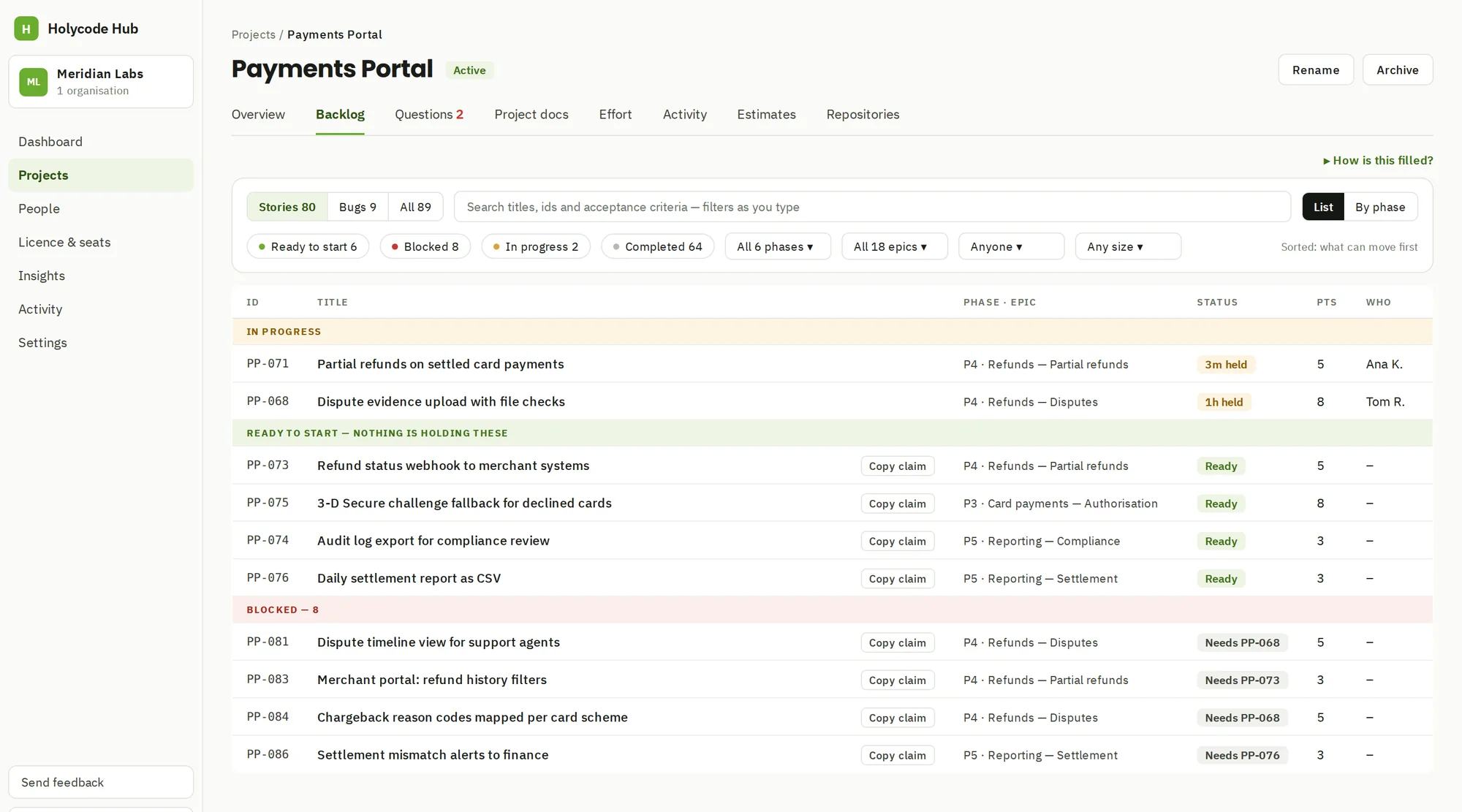
Work is handed out, not divided up
Nobody gets a slice of the plan and interprets it alone. The backlog knows what depends on what, and hands out one unblocked story at a time with its context and acceptance criteria already attached. A claim is an exclusive lease, so two people — or two agents — are never quietly building the same thing.
- ✓The order is computed, not negotiated. The list is sorted by what can actually move first.
- ✓Blocked work names its blocker. Nobody has to ask around to find out why something is stuck.
- ✓One list, two doors. The same backlog whether you came from the coding agent or the browser.
A decision is an object, not a thread
When the agents need a call that only a human can make, it becomes a record rather than a message. It names the stories it is holding up, it carries a proposed default so your job is to accept or overrule rather than compose an answer from a blank box, and it says where it came from.
- ✓Answering is the unblock. The stories it was holding become claimable the moment you click.
- ✓The cost of not deciding is visible. Open since, and how many stories are waiting on it.
- ✓It survives the project. The answer stays attached to the work it shaped, and to the document it changed.

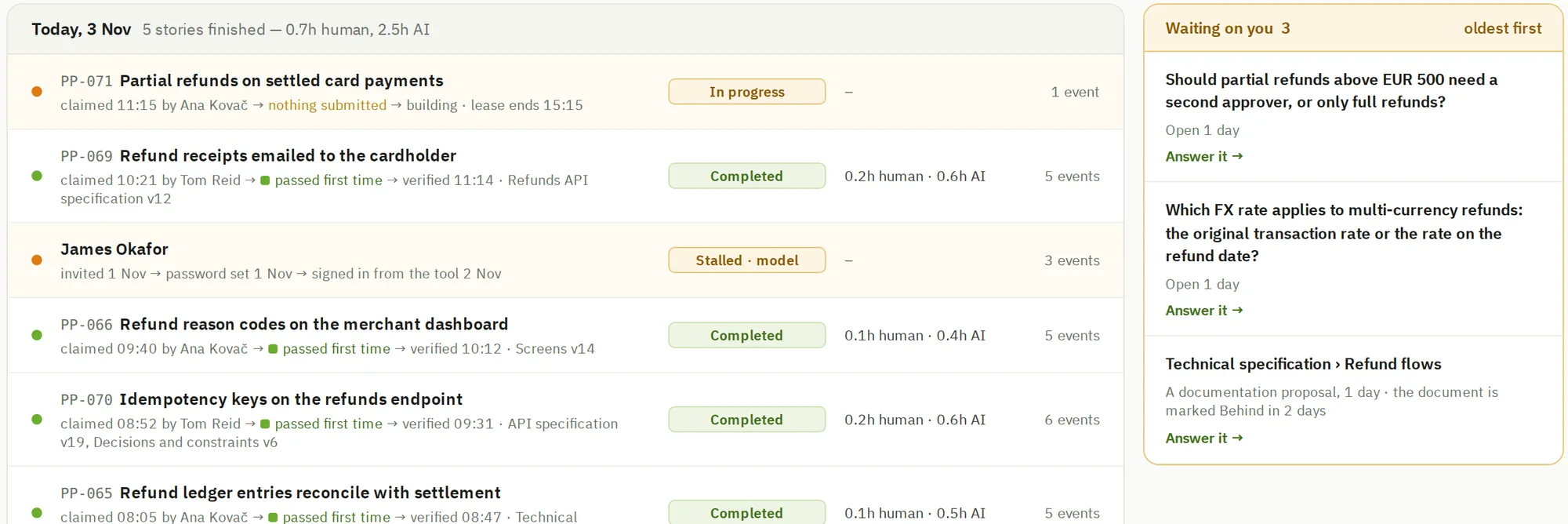
Progress reports itself
Nobody prepares the update. Today, this week, this month — it is a read of the records the work already wrote, in sentences rather than a chart somebody has to interpret. Across every project, Needs you is the short list of things only a person can move, oldest first.
- ✓Written as it happens. Not reconstructed at the end of the week by whoever remembers.
- ✓It volunteers the bad news. Stalled, rejected and abandoned work appears in the same list as the wins.
- ✓A story, not a log. One story’s whole life reads as one entry, not fourteen rows of events.

And the people who only need to watch
A manager, a client or a board member gets a read-only seat on these same screens. Not an export, not a deck somebody assembled on Thursday afternoon — the console itself, one role down.
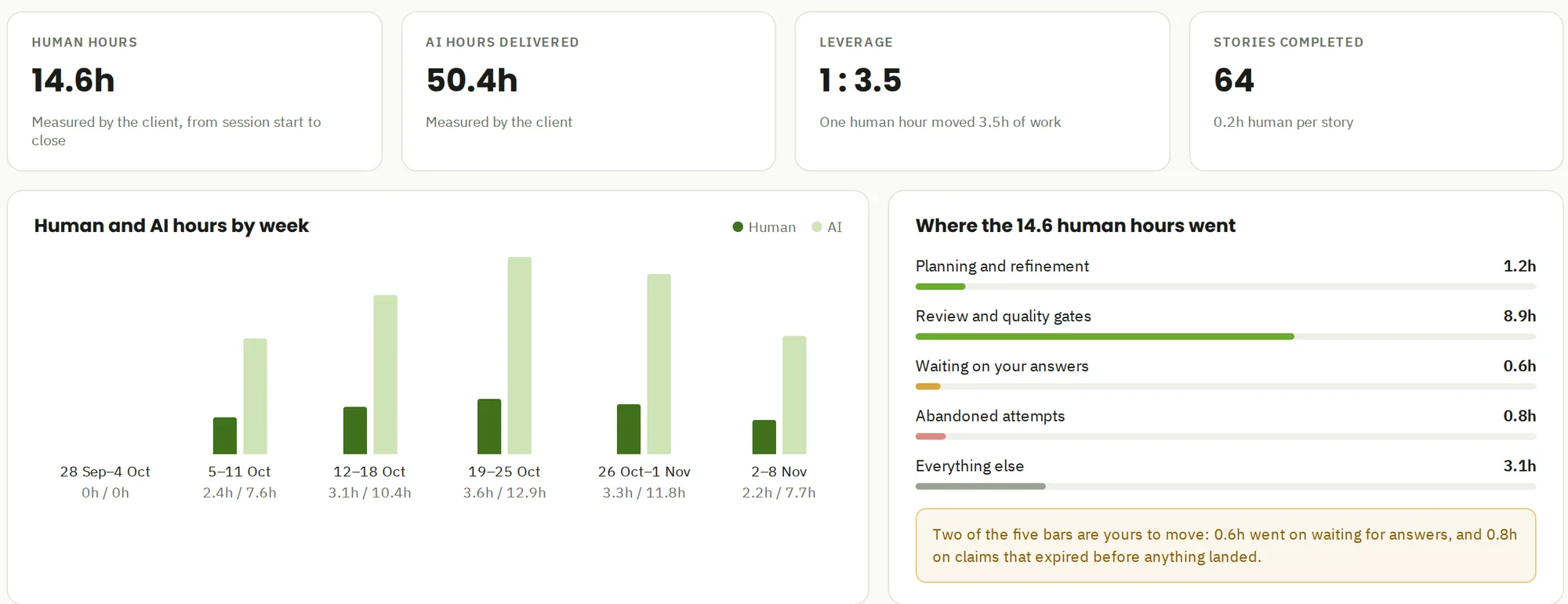
The uncomfortable numbers are on the same screen as the good ones.
Any vendor can show you a velocity chart. The question that matters is whether the system will tell you when it is going badly. Here is the panel from the Hub’s own project, unedited.
What the 41 human hours bought
20 Oct – 2 NovThe bottleneck moves to you
Once building stops being the constraint, your approval speed becomes the schedule. The Hub models this before you commit to anything.
of projected elapsed time would be the agent waiting on a human gate — 398 approvals × 2 h = 796 hours.
That is a projection, not a measurement, and the two-hour turnaround is its assumption. Our own measured waiting time was zero — a small team that answers immediately. Yours will not be zero unless you plan for it, which is the point of showing the projection at all. The Hub tells you which gates are costing you and lets you batch reviews per epic or per phase to buy the time back.
Every estimate is marked against what actually happened
measured phases only — human hours, estimate against actual| Phase | Estimated | Measured | Difference |
|---|---|---|---|
| Core features | 3.6 h | 0.4 h | −90% |
| Org admin rebuild | 34.9 h | 4.1 h | −88% |
| Developer experience & tooling | 7.1 h | 0.5 h | −93% |
| Guidance coverage | 6.7 h | 0.9 h | −86% |
Every phase keeps its estimate beside the human hours it actually took — on your projects as much as on ours. The comparison stays on the screen instead of being filed and forgotten, so you can see where the estimate held, where it did not, and correct the model with evidence rather than instinct. An estimate you cannot check against its own outcome is just a number somebody liked.
Underneath all three panels sits one row per action, written at the moment it happens and never afterwards. A correction is a new event that points at the old one — nothing here is edited or removed. That is the only reason the figures above are worth anything, and it is what you export when you want to check them yourself.
One human hour moved 3.3 hours of work.
Leverage is the number to watch while a team is making the shift, and it is the one the Hub reports by phase so you can see it climb as people learn what to delegate and what to keep.
On the Hub’s own build it ran at 3.9× in early feature work and 8.3× on project administration — the same team, different kinds of work.
- 19–25 Oct
8.8 / 62 - 26 Oct–1 Nov
31 / 70 - 2–8 Nov
0.9 / 3.3
Per seat. And we take nothing on the models.
One licence covers the whole loop — plan, backlog, gates, effort, documentation, audit and due diligence. Model usage is billed to each person’s own account with their model provider, so we have no commercial reason to make the agent chattier than it needs to be.
Growing team
From the 5th userWhat is not on the bill
- ✓Model usage. Billed to each person’s own Claude or OpenAI account. We add no margin.
- ✓Your repository. The code was never ours to charge for.
- ✓Getting your work out. Backlog and documentation export in every licence state, including a terminated one.
For reference, the tooling a Rapid Dev licence replaces — Jira Premium, Confluence Premium, TestRail Professional, Snyk Team and Productboard Pro — comes to about USD 168 per user per month between them. We mention it last because it is the smaller half of the argument: the point is not the subscriptions you stop paying, it is the delivery record you start keeping.
Answered plainly.
Is the code any good, or is it fast slop?
Every submission runs through 108 central quality gates before anything is marked complete — tests, coverage, migration rollback, accessibility, security, changelog and more. The evidence is recorded whether it passes or fails, and the first-time pass rate is on your project’s own overview, not in a brochure. On the Hub’s build it is 92% of 318 submissions, which also means 8% were caught and sent back. That is the system working, and you can see every one of them.
Who owns the code and the intellectual property?
You do, entirely. The work lands as ordinary commits in your own repository, on your own git host. Rapid Dev is the system of record for the plan, the evidence and the documentation — not a place your code lives.
What happens if we stop paying?
Your repository is unaffected because it was never ours. Your project documentation and backlog export in every licence state, including a terminated one — the degradation ladder is never usable to hold your own work hostage. That is a deliberate design rule, not a goodwill gesture.
Whose model subscription pays for the AI?
Yours. Each person connects their own model account or API key in their own settings — Claude or OpenAI — and usage is billed to them directly. We take no margin on model usage and we have no commercial reason to make the agent chattier than it needs to be. Token counts are recorded per story and per model so you can see consumption, but they are deliberately never priced inside the Hub: a team on API keys and a team on subscriptions have no common price, so one euro figure would be wrong for half the room.
Will this work with the agent our developers already use?
Claude Code and Codex are supported today. The Hub is driven over MCP from the coding tool rather than replacing it, so support for others follows the same path — GitHub Copilot and dedicated hosted models, for teams that need the model inside their own boundary, are on the roadmap. Nobody has to abandon the editor they like, and two developers on different agents still pull from the same backlog and clear the same gates.
Do we still need the status meeting?
Not for finding out where things are. Progress, open questions, blocked work, the hours spent and the documents that changed are all reads of the same records the work already wrote — nobody assembles them, and they are current at the moment you look. Stakeholders who only watch get a read-only seat on those screens rather than a report, with commercial figures withheld by their role rather than by whoever was preparing the slides. What the meeting is still for is deciding things, which is a shorter meeting.
What does my team actually have to change?
Developers keep working in their agent. What changes is that work arrives as a claimed story with its context instead of an improvised prompt, and completion requires passing the gates and — where the story declared it — updating the documentation. The heavier change is for whoever reviews: once building stops being the constraint, approval speed becomes the schedule. That is the 48% figure above, and it is the part worth planning for.
Can we see somebody else’s real project?
You are reading one. Every number on this page comes from the Hub building the Hub, over a stated measurement window, including the hours that produced nothing. On a walkthrough we open the live console and you can filter it yourself.
See it on your own backlog.
Bring a real piece of upcoming work. We plan it in the Hub, run the first stories through the gates with you watching, and you leave with the estimate and the evidence trail whether or not you go further.
- ✓Your brief turned into a phased, estimated backlog
- ✓A story claimed, built and taken through the gates, live
- ✓The two scenarios priced side by side — your team as it is, and with Rapid Dev
- ✓An honest read on where your review process will become the bottleneck